Introduction: Empowering the Hands that Build India
The Pradhan Mantri Vishwakarma Kaushal Samman Yojana (PMVKSY) — or simply PM Vishwakarma Scheme — is a flagship government program launched on September 17, 2023, by the Government of India. This visionary initiative aims to recognize, support, and empower traditional artisans and craftspeople who form the backbone of India’s cultural and economic identity.
Through financial aid, modern training, digital integration, and access to credit, PM Vishwakarma ensures that artisans who work with hand tools and traditional skills can transition into the modern economy without losing their craft’s authenticity.
What is the PM Vishwakarma Scheme?
The PM Vishwakarma Scheme is a Central Sector Scheme implemented by the Ministry of Micro, Small and Medium Enterprises (MSME). It offers end-to-end support to artisans and craftspeople — from skill development and financial assistance to marketing and brand promotion.
The government’s core objective is to integrate India’s traditional artisans into formal micro-enterprises, improve productivity, and enable access to both domestic and global markets.
Key Objectives of PM Vishwakarma
- Recognition and Dignity – Providing artisans with a PM Vishwakarma ID and Certificate, giving them formal recognition.
- Skill Development – Offering free skill training (basic and advanced) to improve craftsmanship and business acumen.
- Financial Support – Providing collateral-free enterprise loans at just 5% interest to expand business operations.
- Tool-Kit Subsidy – Granting ₹15,000 worth of tools via e-RUPI vouchers to enhance productivity.
- Digital Integration – Promoting digital payments by rewarding ₹1 for each digital transaction (up to 100 per month).
- Market Linkage – Facilitating access to e-commerce platforms like GeM for nationwide exposure.
- Formalization – Helping artisans move from informal setups to registered, sustainable micro-enterprises.
Eligibility Criteria for PM Vishwakarma
To apply for benefits under the PM Vishwakarma Scheme, artisans must meet the following requirements:
- Occupation: Must belong to one of the 18 traditional family-based trades (e.g., carpenter, potter, blacksmith, tailor, goldsmith, barber, etc.).
- Age Limit: The applicant must be 18 years or older.
- Employment Status: Must be self-employed and actively working in the artisan trade.
- Loan History: Should not have availed credit-based schemes like PMEGP or MUDRA in the last 5 years.
- Family Limit: Only one member per family is eligible.
- Exclusion: Government employees and their families are not eligible.
List of 18 Trades Covered Under PM Vishwakarma
| Trade | Description |
|---|---|
| Carpenter (Suthar) | Woodworkers crafting furniture and household items |
| Boat Maker | Builders of wooden or fiberglass boats |
| Armourer | Craftsmen making protective gear and weapons |
| Blacksmith (Lohar) | Metalworkers shaping iron and steel tools |
| Hammer & Tool Kit Maker | Producers of hammers, chisels, and other implements |
| Locksmith | Makers of locks, keys, and mechanical devices |
| Goldsmith (Sonar) | Designers and makers of gold and silver ornaments |
| Potter (Kumhar) | Clay artists creating pottery, tiles, and utensils |
| Sculptor (Moortikar) | Creators of idols and stone sculptures |
| Stone Breaker | Masons specializing in stone cutting and shaping |
| Cobbler (Mochi) | Leatherworkers crafting footwear and repairs |
| Basket/Mat/Broom Maker | Creators of household woven items |
| Doll & Toy Maker | Artisans making wooden and clay toys |
| Barber (Nai) | Traditional hairstylists and groomers |
| Garland Maker (Malakar) | Florists making garlands and floral arrangements |
| Washerman (Dhobi) | Traditional laundry and pressing services |
| Tailor (Darzi) | Designers and makers of clothing |
| Fishing Net Maker | Artisans crafting handmade nets for fishermen |
Key Benefits of the PM Vishwakarma Scheme
1. Skill Development Training
Artisans receive two levels of training:
- Basic Training: A 5–7 day orientation introducing modern techniques and business practices.
- Advanced Training: A 15-day specialized session for scaling craft production and digital literacy.
Training Stipend: ₹500 per day during training to support income loss during learning.
2. Tool-Kit Incentive (₹15,000 e-Voucher)
Each registered artisan receives a one-time tool grant worth ₹15,000, distributed through e-RUPI or direct bank transfer, allowing them to purchase modern equipment for their craft.
This upgrade helps artisans increase efficiency, enhance product quality, and meet larger orders.
3. Financial Support through Collateral-Free Loans
One of the most attractive features of the PM Vishwakarma Scheme is the two-phase enterprise loan system:
| Loan Phase | Amount | Duration | Conditions | Interest Rate |
|---|---|---|---|---|
| First Tranche | ₹1 Lakh | 18 months | Post completion of basic training | 5% |
| Second Tranche | ₹2 Lakh | 30 months | Upon successful repayment of first loan and advanced training | 5% |
The Government of India subsidizes the interest above 5% and covers credit guarantee fees, ensuring that artisans do not face financial risk.
4. Digital Transaction Incentives
Artisans are encouraged to embrace digital payment systems. For every successful digital transaction, they receive ₹1 incentive, up to 100 transactions per month.
This initiative encourages financial transparency and helps artisans participate in the digital economy.
5. Market Access and Brand Development
The government provides multiple forms of marketing support, including:
- Branding and Packaging Guidance
- E-commerce Onboarding (GeM, Amazon Karigar, etc.)
- Exhibition Participation and trade fairs
- Quality Certification for export readiness
This ensures that products made by Vishwakarma artisans find markets both domestically and internationally.
Registration Process for PM Vishwakarma
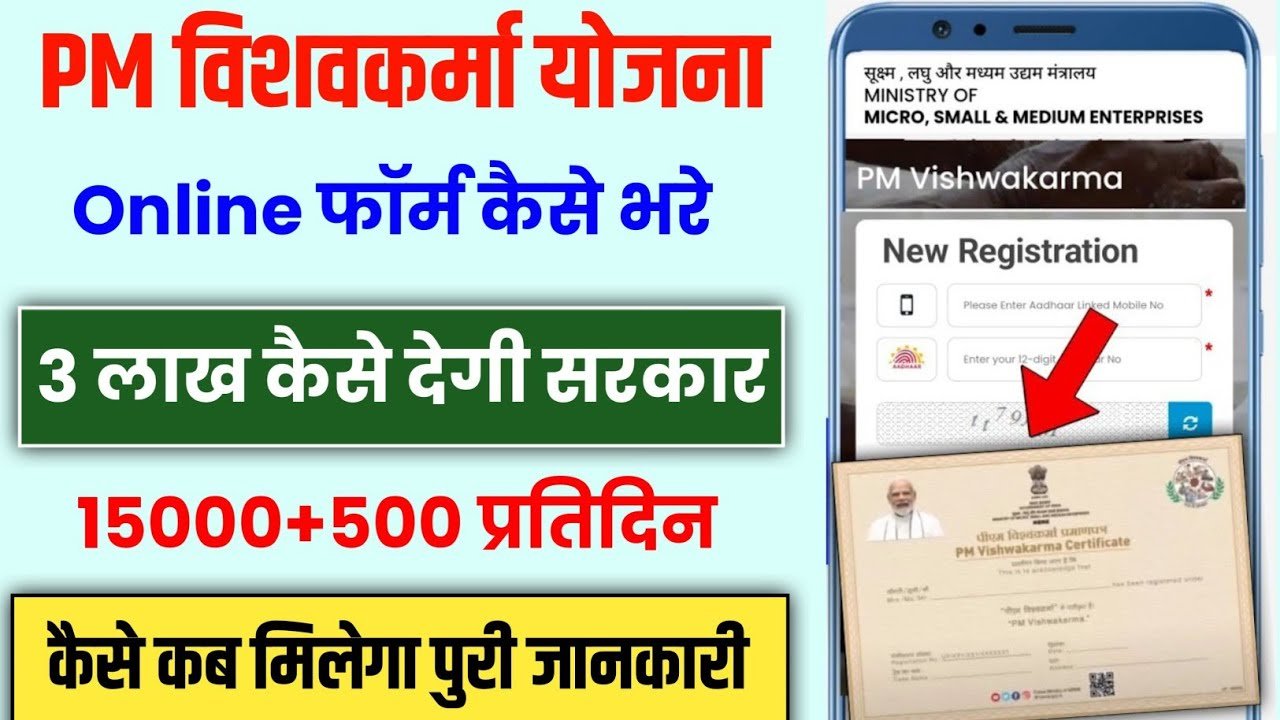
The registration process is completely online through the official website pmvishwakarma.gov.in.
Step-by-Step Process
- Visit the official PM Vishwakarma Portal.
- Click on “Apply Now.”
- Log in using your Aadhaar number and mobile OTP verification.
- Fill in your personal, family, and professional details.
- Upload required documents (Aadhaar, photo, trade proof).
- Select your trade and training preferences.
- Submit your application.
- Await Gram Panchayat or Urban Local Body verification.
Once verified, the applicant receives a PM Vishwakarma Certificate and ID Card, which are essential to access benefits like loans and training.
Monitoring and Implementation Structure
The scheme operates through a multi-tier implementation framework:
- Central Level: Ministry of MSME manages national rollout.
- State Level: State-level coordination committees oversee execution.
- District Level: District Project Management Units (DPMUs) handle beneficiary verification and training logistics.
- Local Level: Common Service Centres (CSCs) serve as registration and grievance redressal points.
Real Impact: Empowering Artisans Nationwide
Since its launch, PM Vishwakarma has shown remarkable progress:
- Over 30 lakh artisans registered across India.
- More than 26 lakh skill verifications completed.
- Over 20 lakh e-vouchers distributed for tool kits.
- Thousands of artisans have successfully received loans and training certificates.
The initiative is rapidly bridging the gap between traditional skills and modern opportunities.
Challenges and Solutions
While the scheme’s progress is commendable, certain challenges remain:
1. Limited Awareness
Many rural artisans are unaware of the scheme’s full potential.
Solution: Conduct nationwide awareness drives through panchayats, NGOs, and local trade fairs.
2. Delayed Loan Processing
Some banks face backlogs in loan approvals.
Solution: Introduce dedicated MSME desks in every bank branch to speed up approvals.
3. Skill Relevance
Training modules must evolve with changing market demands.
Solution: Collaborate with industry experts and design institutes for updated curricula.
4. Market Penetration
Artisans struggle to find buyers for their products.
Solution: Expand e-commerce partnerships and create regional “Artisan Bazaars.”
The Road Ahead: Future Vision of PM Vishwakarma
The government aims to broaden the scheme’s scope in the coming years by:
- Adding more traditional trades based on regional crafts.
- Enhancing export opportunities for artisan products.
- Promoting cluster-based manufacturing hubs.
- Encouraging green and sustainable production methods.
- Integrating AI-driven monitoring systems for transparency.
The next phase will focus on credit empowerment, digital inclusion, and global branding.
Conclusion
The Pradhan Mantri Vishwakarma Scheme stands as a landmark initiative that bridges the gap between India’s rich artisanal legacy and the modern economic ecosystem. By offering skill training, financial inclusion, digital empowerment, and market access, it paves the way for sustainable growth and self-reliance among millions of traditional artisans.
In essence, PM Vishwakarma is not just a government scheme — it’s a national movement to restore the pride, prosperity, and productivity of the hands that shape India’s cultural heritage.